
 Bible believers are beside themselves about the prospect that marriage norms and laws are changing, but let me tell you a secret about Bible believers that I know because I was one. Most don’t actually read their Bibles.
If they did, they would know that the biblical model of sex and marriage has little to do with the one they so loudly defend. Sex in the Bible includes rape, incest, master-slave sexual relations, captive virgins, and more. Of course, just because a story is told in the Bible doesn’t mean it is intended as a model for moral behavior. Does God forbid or command the behavior? Is it punished or rewarded? In the New Testament stories, does Jesus change the rules or leave them alone? By these criteria, the Bible not only describes many forms of sexual relationships (including sexually coercive relationships), it gives them the divine thumbs up.
Not One Man, One Woman
The God of the Bible explicitly endorses polygamy and sexual slavery and coerced marriage of young virgins along with monogamy. In fact, he endorses all three to the point of providing detailed regulations. Based on stories of sex and marriage that God rewards and appears to approve one might add incest to the mix of sexual contact that receives divine sanction.
New Testament Endorses Old Testament
Nowhere does the Bible say, “Don’t have sex with someone who doesn’t want to have sex with you.” Consent, in the Bible, is not a thing. Furthermore, none of the norms that are endorsed and regulated in the Old Testament law – polygamy, sexual slavery, coerced marriage of young girls—are revised, reversed, or condemned by Jesus. In fact, the writer of Matthew puts these words in the mouth of Jesus:
Do not think that I have come to abolish the Law or the Prophets; I have not come to abolish them but to fulfill them. I tell you the truth, until heaven and earth disappear, not the smallest letter, not the least stroke or a pen, will by any means disappear from the Law [the Old Testament] until everything is accomplished. (Matthew 5:17-18)
The Law of which Jesus speaks is the Law of Moses, or the Torah, and anyone who claims the Bible as the perfect word of an omniscient, omnipotent, omnibenevolent God should have the decency to read the Torah carefully—and then keep going.
Polygamy. Polygamy is a norm in the Old Testament and accepted in the New Testament. Biblicalpolygamy.com has pages dedicated to 40 biblical figures, each of whom had multiple wives. The list includes patriarchs like Abraham and Isaac. King David, the first king of Israel may have limited himself to eight wives, but his son Solomon, reputed to be the wisest man who ever lived had 700 wives and 300 concubines! (1 Kings 11)
Sex Slaves. Concubines are sex slaves, and the Bible gives instructions on acquisition of several types of sex slaves, although the line between biblical marriage and sexual slavery is blurry. A Hebrew man might, for example, sell his daughter to another Hebrew, who then has certain obligations to her once she is used. For example, he can’t then sell her to a foreigner. Alternately a man might see a virgin war captive that he wants for himself.
War Booty. In the book of Numbers (31:18) God’s servant commands the Israelites to kill all of the used Midianite women who have been captured in war, and all of the boy children, but to keep all of the virgin girls for themselves. The Law of Moses spells out a purification ritual to prepare a captive virgin for life as a concubine. It requires her owner to shave her head and trim her nails and give her a month to mourn her parents before the first sex act (Deuteronomy 21:10-14). A Hebrew girl who is raped can be sold to her rapist for 50 shekels, or about $580 (Deuteronomy 22:28-29). He must then keep her as one of his wives for as long as she lives.
Brother’s Wife. A man might acquire multiple wives whether he wanted them or not if his brother died. In fact, if a brother dies with no children, it becomes a duty to impregnate his wife. In the book of Genesis, Onan is struck dead by God because he fails to fulfill this duty – preferring to spill his seed on the ground rather than providing offspring for his brother (Genesis 38:8-10). A New Testament story shows that the tradition has survived. Jesus is a rabbi, and a group of scholars called Sadducees try to test his knowledge of Hebrew Law by asking him this question:
Teacher,” they said, “Moses told us that if a man dies without having children, his brother must marry the widow and raise up offspring for him. Now there were seven brothers among us. The first one married and died, and since he had no children, he left his wife to his brother. The same thing happened to the second and third brother, right on down to the seventh. Finally, the woman died. Now then, at the resurrection, whose wife will she be of the seven, since all of them were married to her?” (Matthew 22:24-28).
Jesus is too clever for them and points out that in Heaven, that place of perfect bliss, there is no marriage.
Having a brother act as a sperm donor isn’t the only biblical solution to lack of offspring. The patriarch Abraham is married to his half-sister Sarah, but the two are childless for the first 75 years or so of their marriage. Frustrated, Sarah finally says, “The LORD has kept me from having children. Go, sleep with my slave; perhaps I can build a family through her.” Her slave, Hagar, becomes pregnant, and then later Sarah does too and the story gets complicated (Genesis 16). But that doesn’t stop Abraham’s grandson Jacob from participating in a competition, in which his two wives repeatedly send in their slaves to get pregnant by him, each trying to get more sons than the other (Genesis 30:1-22).
Bible Believers or Simply Change-Averse?
These stories might be irrelevant to the question of biblical marriage were it not that Bible believers keep telling us that God punishes people when he dislikes their sexual behavior. He disliked the behavior of New Orleans gays so much, according to Pat Robertson, that he sent a hurricane to drown the whole city – kind of like Noah’s flood. And yet, according to the Bible story, both Abraham and Jacob were particularly beloved and blessed by God.
The point is that marriage has changed tremendously since the Iron Age when the Bible was written. For centuries, concubines and polygamy were debated by Christian leaders – accepted by some and rejected by others. The nuclear family model so prized by America’s fundamentalist Christians emerged from the interplay between Christianity and European cultures including the monogamous tradition of the Roman Empire. As humanity’s moral consciousness has evolved, coerced sex has become less acceptable even within marriage while intertribal and interracial marriage has grown in acceptance. Today even devout Bible believers oppose sexual slavery. Marriage, increasingly, is a commitment of love, freely given. Gay marriage is simply a part of this broader conversation, and opposition on the part of Bible believers has little to do with biblical monogamy.
Since many Christians haven’t read the whole Bible, most “Bible believers” are not, as they like to claim, actually Bible believers. Biblical literalists, even those who think themselves “nondenominational,” almost all follow some theological tradition that tells them which parts of the Bible to follow and how. Granted, sometimes even decent people do get sucked into a sort of text worship that I call bibliolatry, and Bible worship can make a person’s moral priorities as archaic and cruel as those of the Iron Age tribesmen who wrote the texts. (I once listened, horrified, while a sweet, elderly pair of Jehovah’s Witnesses rationalized the Old Testament slaughter of children with the same words Nazis used to justify the slaughter of Jewish babies.)
But many who call themselves Bible believers are simply, congenitally conservative – meaning change-resistant. What really concerns them is protecting the status quo, an ancient hierarchy with privileged majority-culture straight males at the top, which they justify by invoking ancient texts. Freedom to marry will expand, as will other rights related to sexuality, reproduction, and family formation; and these Bible believers will adapt to these changes as they have others: reluctantly, slowly and with angry protests, but in the end accepting the new normal, and perhaps even insisting that it was God’s will all along.
————-
More from the Bible at Awaypoint:
Mandrakes and Dove Blood: Biblical Healthcare Anyone?
If the Bible Were Law, Would You Qualify For the Death Penalty?
What the Bible Says About Rape and Rape Babies
Woman’s Hanging and Burning of Dog Biblical
Valerie Tarico is a psychologist and writer in Seattle, Washington and the founder of Wisdom Commons. She is the author of “Trusting Doubt: A Former Evangelical Looks at Old Beliefs in a New Light” and “Deas and Other Imaginings.” Her articles can be found at Awaypoint.Wordpress.com.


 AwayPoint
great article. Genesis 19:15-30 is about something else though–just in case you want to fix the reference
LikeLike
Oops. Thank you! It’s Genesis 30:1-22. Who knows how I swapped in the other reference!
LikeLike
That’s not the only thing you swapped…
Quote (by you):
“Nowhere does the Bible say, “Don’t have sex with someone who doesn’t want to have sex with you.” Consent, in the Bible, is not a thing.”
Bible quote (Song of Songs 2:7):
“…That you do not arouse or awaken my love Until she pleases.”
I admit it’s a poor translation, but it means you cannot start sexual love, untill it pleases her. So not have sex, until she is ready for it.
PS: This was written in the Old Testament, by King Solomon (who had a thousand wives) but even though he was an absolute ruler, he would not rape his own wife(s).
PS2: New Testament says a (Christian)man (who must also be the priest/bishop of his own family) can have only 1 wife (1 Tim.3:2)
LikeLike
While I understand your concern to defend the moral coherence of the Bible, it simply doesn’t hold. The verse to which you are referring is erotic poetry. By contrast, when it comes to law and foundational narratives, there is no indication that a woman’s consent is required–rather the opposite. And does not the phrase “who had 1000 wives” ring some hogwash bells in your head. Imagine the cost of acquiring and maintaining that many wives plus hundreds more sex slaves (which we are also told that he had) in an Iron Age tribal culture. The “kings” of Israel and Judah were more like what we would think of as tribal chiefs, not like European monarchs. Also, imagine how silly that would be. A woman from every village and surrounding polity? Two? Three?
LikeLiked by 1 person
How about Catholic bishops/priests sodomizing young boys in churches, yet the congregate to stop contraception. They are plain hypocrites
LikeLike
When was the last time one of these boys got pregnant?
LikeLike
The point Mr Kwi is making is that the church is against people having sexual ownership over their own bodies.
LikeLike
What is that comment supposed to mean? Jo
LikeLike
That was my first thought, too, and I almost replied “LOL” to your comment, but stopped myself because there is nothing funny about any of this, other than the wording.
LikeLike
They should, then, be raping girls? If the girls are virgins, they are to offer fifty silver shekels and offer to marry them. If they can find girls who aren’t virgins, and aren’t engaged, they get off easy!
When they are raping girls they aren’t doing unnatural things as long as they don’t use the wrong orifices and get off in the right one. None of that contracepting, either. That’s a Mortal Sin that requires more than a few Hail Marys and Our Fathers to expiate, and they’d better do their prayers in Latin so that God can understand them!
LikeLike
I agree, religion is man-made and has nothing to do with a loving God. Religion is a smokescreen that allows perversion in the name of God.Religions have started more wars than anything else in this world. The content of the 4 books attributed to Moses are filled with crap. Nobody in their right mind in the 21 century would believe this bunk.
LikeLike
Not everyone who professes to be a Christian is one. Claiming to be a Christian doesn’t make one a Christian. And being a Christian doesn’t make one faultless.
The New Testament, in Acts Chapter 2, tells how to become a Christian. The New Testament had not begun to be written at that time. People learned by witnessing and by word of mouth until the first of the NT began to be written. The apostles went about preaching and teaching.
LikeLike
Refreshing readable clarity.
LikeLike
Valerie,what an erudite article on religion,or the lack of it.I share your views and embrace your sentiments.Thank you .
Regards
Mike—-in England
LikeLike
Thank you!!! As I continue my searching (at 66 going on 67 – you’d think I’d be a little closer) as to what “I” believe and not what I’ve been “told” to believe, this one article has provided such help.
LikeLiked by 1 person
How about some bishops/priests cozying up young boys in churches, yet the congregate to stop contraception. They are plain hypocrites
Reply
LikeLike
What is the Catholic hoo-ha over contraception? Boys don’t get pregnant no matter how many priests rape them how many times. Without contraceptives. And without doing anal Onanism. (Ananism?) Or do some priests like girls?
LikeLike
Great article Valerie Tarico. Raised as a Missionary Baptist, I was required to read the Bible a number of times. My favorite quote, which was heard quite a bit during Summer Vacation Bible School, was “Now wait a minute”. True, parts of the Bible are beautifully written and can provide comfort in the darkest of time. But thou should not get it twisted(th)…that good book was written by a bunch of men…not like they have NEVER fallen victim of…fallibility, right?
LikeLike
Hello. Yes, I am a Christian – I guess a modern one, you might say. I am not a loud-mouthed (or non-loud-mouthed) Republican nor am I a Pat Robertson type nor am I like any of the misguided false-speaking so-called Christians who pollute the name of Christianity. I don’t believe in other people telling women what to do with their bodies; I love my gay friends; I don’t think they’re going to hell for being gay. You’re right that a lot of Christians have not read their own Bibles. That said, there are many who have and continue to, who do follow the message that Christ gave. Furthermore, if you read the entire Bible over and over but fail to recognize what it refers to, fail to understand, or know what to take away from what you’re reading, then you really don’t know what you’re talking about either (that goes for Christians and non-Christian readers alike). You have to really study your Bible with scholarly knowledge to really know what is being said.
“Stories depicted in the Bible include rape, incest, master-slave sexual relations, captive virgins, and more. Now, just because a story is told in the Bible doesn’t mean it is intended as a model for devout behavior. Other factors have to be considered, like whether God commands or forbids the behavior, if the behavior is punished, and if Jesus subsequently indicates the rules have changed, come the New Testament. ”
^ People say this all the time. Yes, the Bible speaks of these things, and as you say, if you take everything out of context and proclaim that since the Bible speaks of this then that’s what must be done, then it’s just irresponsible.
“Furthermore, none of the norms that are endorsed and regulated in the Old Testament law – polygamy, sexual slavery, coerced marriage of young girls—are revised, reversed, or condemned by Jesus. In fact, the writer of Matthew puts these words in the mouth of Jesus:
Do not think that I have come to abolish the Law or the Prophets; I have not come to abolish them but to fulfill them. I tell you the truth, until heaven and earth disappear, not the smallest letter, not the least stroke or a pen, will by any means disappear from the Law [the Old Testament] until everything is accomplished. (Matthew 5:17-18) ”
^ Do you know what the Matthew verses you listed mean? I’m not sure what the relevance is for bringing that to your article. Before Christ came to earth, you see in OT times that there are many prophecies prophesied about referring to the coming of the Christ who will “fulfill the Law.” He is saying He has come to be the lamb on the cross. You’re making an indirect reference by bringing that scripture to your topic when there is no real relevancy.
You referenced a wiki link – respectfully I’d advise that if you what to bring credence to your article, you shouldn’t be using wikipedia as a source.
With genuine respect, as I am not an uncivil person who chooses foolishly to slander folks who believe differently, I say this to you: if you used to find yourself one of the faithful and have fallen away, how much of a believer were you really, and how much did you even know your own faith? To know Christ, truly, is to be pierced in the heart with the recognition of His love. Few truly know that and walk away unbelievers. I know some people don’t appreciate it or feel offended, but I truly hope you don’t take offense to this: I will pray for you. I also hope you examine your own self and what you currently believe in or still believe in.
LikeLike
Thank you Gwen for your words – I too am a Christian and a Catholic. But again, I too have my own mind and thoughts regarding the OT and the words of Jesus. It would seem that anyone can take what is writted and twist the words to make them justify their position. And yet, if one truly has experienced the love of Christ they know it isn’t necessary. There are no words that need to be spoken – actions are what will touch the heart and make the difference. And then, Christ’s love can be experienced through another – whether gay or straight……because the one great commandment besides the order to Love is to not judge – and it would seem that all religions have forgotten that one – or at least think they alone have that right. Again – thanks for your thoughts – From another Christian who loves the Lord. Patti
LikeLiked by 1 person
“You have to really study your Bible with scholarly knowledge to really know what is being said.”
Can you please explain to me the scholarly explanation to: “Do not allow a sorceress to live.” -Exodus 22:18
“People say this all the time. Yes, the Bible speaks of these things, and as you say, if you take everything out of context and proclaim that since the Bible speaks of this then that’s what must be done, then it’s just irresponsible.”
You sound very knowledgeable on the apologies for the bible. Can you please tell me the context that makes it okay for the Holy Book to instruct on how to obtain, rape, control, beat, etc. slaves and never once mention that it even MIGHT not be okay to own people as farm equipment? By the way, this is not just an Old Testament thing I am referring to here, as you know, for Jesus Himself, “the gentle, meek and mild” also instructs specifically on how and when to beat your slaves. I think there is a reason people say these things “all the time,” because believers righteously persecute in the name of this book, yet don’t mention or follow equally contextualized scripture.
“You’re making an indirect reference by bringing that scripture to your topic when there is no real relevancy.”
The relevancy is to the common and therefore expected arguments that wave horrific nonsense from the bible away by claiming that it’s from the Old Testament and the New Testament has given a new law that replaces the Mosaic Laws. Which as I’m sure you know, is nonsense. It also tempts the throwing away of the Decalogue.
“You referenced a wiki link – respectfully I’d advise that if you what to bring credence to your article, you shouldn’t be using wikipedia as a source.”
You may not be aware, but Wikipedia is one of the most solid sources you can give, because it single-handedly provides multiple sources, that have been checked by multiple other people to make sure they are truly relevant and respectable. This is also just strange advice coming from someone who doesn’t give a single source in her response. Especially while talking about “the scholars.”
“I am not an uncivil person who chooses foolishly to slander folks who believe differently”
Well, I’m sure you don’t CHOOSE to do that, but I’m not sure that actually prevents you from doing just that.
“if you used to find yourself one of the faithful and have fallen away, how much of a believer were you really, and how much did you even know your own faith?”
Well now, this is a weak argument isn’t it. Especially on account of factually speaking, non-believers have been proven to know more about Christianity than Christians do.
http://www.theatlanticwire.com/national/2010/09/why-do-atheists-know-more-about-religion/22880/
Do you seriously want to claim that every single x-believer was never a “true believer?”
“I will pray for you.”
Please feel free to do this for me as I will not be offended. Admittedly, I won’t care though either.
LikeLiked by 3 people
Well said.
LikeLike
You said: “Well now, this is a weak argument isn’t it. Especially on account of factually speaking, non-believers have been proven to know more about Christianity than Christians do.”
This is factually incorrect, and the link you provided to support your quote actually says the opposite. Did you even bother to read the link you provided, or did pull a fast one, hoping one would actually read it? Please read the link again. http://www.pewforum.org/2010/09/28/u-s-religious-knowledge-survey/
For those who don’t want to read the link, I will summarize: the average non-believer knows less than the average Christian about Christianity (5.3/10 vs. 6.2/10). If we break the non-believers down further, the atheists/agnostics know more than those who check off “nothing in particular.” The score of 6.3 is below Mormons (7.9) and protestants (6.5), but above Catholics (5.4). The reason why Catholics are so low is because a huge percentage of Catholics are nominal or cultural Catholics, who don’t practice the faith. By contrast, almost all Mormons practice their faith, hence the high score.
LikeLike
Unfortunately the Bible doesn’t tell a husband how to beat his wife. Does that mean he is not approved by God in beating his wife, or just that He isn’t particular as to how a man beats his wife?
After all, a father is told to beat his son with a rod, and if he doesn’t (if the son is disobedient, disrespectful?), he hates his son. The Bible doesn’t go into detail about where to whack, how hard, and so on.
But as to disobedient, disrespectful, nagging, gossiping, slovenly, slutty (once meaning a sloppy, unkempt housekeeper), bitching wives, how are their husbands to correct them? Sure, he should examine himself to see if he’s inciting or enabling her misbehavior, seek the counsel of successful husbands and fathers, but if it turns out that it really isn’t his fault, what then?
If she’s sexually unfaithful, he at one time could ask the government to put her to death upon conviction, but Jesus said to forgive “seventy times seven,” not cast the first stone. Seems like it would be better to give her a sound paddling and love her. But the Bible doesn’t say one way or another.
LikeLike
Very well put Frank
LikeLike
By teaching, “Whatsoever you would have others do unto you, do likewise unto them,” He reduced slavery to a virtually employer-employee relationship.
If the rôles were reversed, how would you want your now-master to treat you, now his slave?
Though fitted by biology, nature, to different rôles, how would you, husband, want your wife to treat you if you were the wife and she, now he, your husband?
LikeLike
If Jesus was eliminating slavery, what a shame he didn’t say so more explicitly. Imagine how different world history would be if the Bible, anywhere, said “Thou shalt not own another person.” (Or, for that matter .. . . Don’t have sex with anyone who doesn’t want to . . . or Wash your hands after going to the bathroom. . . . Or don’t eat anything with eyes and a face . . . or Heaven is a forest, a perfectly tuned and sacred web of life (instead of Heaven is full of mansions made of gold and precious gems). . . I could go on.
LikeLike
Jesus didn’t eliminate slavery. His teachings reduce it to hardly more than a legal status. If a master follows Jesus’ teachings on how to treat his fellow man (human being of both genders), he cannot hold his slave by force.
Study the life work of William Wilberforce, who led the drive to delegitimize first, slavery within the British Isles, then to outlaw it in the home islands, and finally throughout the British Empire. He was motivated, energized, by the doctrine of Christ.
Paul apostle didn’t confront Philemon, demanding that he free Onesimus. He counseled him to no longer treat Onesimus as a slave but as a fellow Christian brother.
In a slave society, Christians don’t organize to forcibly overthrow the government. They instead buy slaves, then treat them according to Jesus’ instruction on how to treat one’s fellow man. This in effect frees them, as slavery requires force to keep the slaves from walking off at will.
Slavery not only oppresses the slave. It destroys the heart of the slaver and the master. It is as a continuous state of war, with one side, the slaveocracy, constantly robbing the other side, the slaves, of their labor. Even when the slaves prefer their slavery to the alternative, it is because the alternative is starvation, enslavement by worse masters, or death.
Jesus’ doctrine, if followed, does away with the element of force, of coercion. He teaches that the sun is not to set on the laborer’s wages, and that the wage promised be paid without shorting the laborer in his compensation. He teaches to be generous with alms, which are to be given voluntarily without threats or violence. The beggar is not to threaten to rob the hoped-for donor. The person who wishes to benefit the needy is to give of his own means, not to compel another.
These are a lot to ask of people, but the closer to these ideals people can get, the better.
Labor is what is desired by the master of his (her) slaves. Few slaves were raised to be eaten, or for manufactures to be made of their hides, soap of their fat. If your labor is taken from you without your consent, you are a slave to the extent of the amount of your labor that is confiscated.
LikeLike
You DO realize that most of the New Testament was allegedly written by ONE man who, by all research accounts, had some serious megalomania going on. He was in direct competition with Peter and Rome as to who got to set up the Jesus cult, right?
As for using Wikipedia as a source: how precious of you to look down upon it. If you actually clicked on the link, you would discover that the article is annotated and has proper citations. In fact, most scholarly articles posted on Wikipedia are better researched and documented than those that appear in what is left of the Encyclopedia Britannica. Yeah, the truth is that regular encyclopedia pieces are written much the same way, as are the articles in academic journals. I know–as a grad student, I was “honored” with the task of proofreading the work of professors who lived and died by their publication record. Pretty much Wiki on steroids…
Offering to pray for others is pretty damned obnoxious and makes you a bit of a poser.
LikeLiked by 1 person
You angry, girl?
LikeLike
… Which Bible? The various books making up the Canon were written in wildly different settings, and had authors with wildly different concepts of GOD. These cannot be logically harmonized.
Heck, we didn’t even have a Canon until a dude named Marcion went through the scroll library. His conclusion was that the OT GOD was not the same as the one taught by Joshua Ben Joseph. Marcion tossed out a ton of scrolls, picked ones he liked, and assembled it into the first real canon.
Seriously. There are, offhand, three different Jesus in the New Testament. You have Josh “Normality Sucks” who taught the destruction of the family unit, anarchy, and armed violence against neighbours. Then there’s Joshua “The Righteous” who said that you have to be better at following rules than the dudes who teach them. Or “Gandhi” Jesus, who promote peacemaking, nonviolence, and generally not being a dick.
Just sayin’.
LikeLiked by 1 person
You generally don’t follow the advice in your very last phrase, do you?
LikeLike
Good answer bro!
LikeLike
I find it interesting when people tell other people how to percieve doctrine as though they were there in the midst as it was being written or spoken by the actual author. This goes to show you how bias people are especilly when an idea caters to thier point of view, it really makes it so easy for them to defend. Plain and simple by any means one has to look at interpretation, which seems to be the real issue here. Given the times we live in and how we have all evolved on social and political issues it’s no woder why when it comes to a particular religious doctrine we all seem to migrate to those who share similar beliefs hovever they may be spawned.
Nonetheless I would have to disagree with your point of view on “relevance” and I’ll reasonably give you the benefit of the doubt, that you probably didn’t contemplate the material here written by the author with considerable thought. After reading your comment I honestly feel you missed her point and if I am wrong I wouldn’t mind being respectfully corrected, but if I could take a guess at it my presumtion would be that she was saying if these acts were not acceptable in N.T. times then why would they be acceptable in the begining (O.T.)? If they weren’t, acceptable then why was it not even addressed at all?
Through my readings I have found textual scripture that would make ones puzzler reallly puzzled into a elaborate knot. Ex. 1.) Gen. says God made the earth frankly out of nowhere on “set” days as stated in the passages with the sun, moon, stars, firment , water, land, animals etc., etc. given the chronology of events, where did the dinosaurs and neanderthal man come into play…???
EX. 2.) In that same book it states that God made man in his own image (GEN. Chp. 1 / V26-31 [KJV] Bible) and through out those verses has an “exntensive ” one-way dialog apparently, and that was, as it appears on the “sixth day”. Ok here is where it gets interesting he, God rests, then it states he then on the “seventh day” (GEN. Chp. 1./ Verse 5 that there was “NO MAN TO TILL THE GROUND” BUT WAIT, there’s more Verse 7. plainly states he makes Adam and then God says that it was not good for man to be alone, so he makes Eve of course. Now let’s stop right here, now I’m no mathematician or doctrinal scholar (Not that I feel Ihave to be on this topic), but last time I checked regardless of creative writting I do know how to count and not to mention I also have at least a brown belt in common sense. How can there be “no man to till the ground if he already made man on the “sixth day”? Also again, where are the “DINOSAURS” especially if he made “man” within a week??? (Day1, Day 2, Day 3….etc.) The night and the evening is the pattern here,so obviously there’s no room for excusses there.
Anyhow I have more like sins that were commited before the 10 Commandments byyy Abraham and Sarai-
Ex. 1.) When God told Abram to leave his country (Ur) and traveled through Egypt and Abram had Sarai lie so he would not be killed. Ex.2.) Also Sarai lied when the angles of the Lord told Abraham that he would have a son BY SARAH even after he basically committed adultery by N.T.times with Haggar. Alos the angel asked Sarah why she laughed about having a child at such a old age the angel replied ” Is anthing “too” hard for Lord?” I mean come on, these are his chosen people right??? “All” have fallen shor
It would appear as though some people had some serious VIP status in those days. DESPITE some of the sins they committed which is the essential point here in conjunction with the article as best I can tell. In addition the only conclusion I can presently come to is that this was all PREDESTINED, since God knows what we will be like or do before we are even born, which would suggest our fate has already been determined… maybe., …???
HONESTLY I don’t see how one can justiify any of these acts,for there appears to be a pattern to some extent. The thing that common knowledge teaches us even in todays world from the very begining of it, is that if something is considered “sinful” or wrong at the later half then it must be “sinful” or wrong at the “VERY BEGINNING”, otherwise the practice there of would “appear” to be contradictive or biased from a rationalized perspective. If this is not the case then I and many others would respectfully, curiously and anxiously request an understandable explaination. Otherwise we are left with mans own devices (Own interpretations) which are obviously fallible to even the point where God himself according to Gen. Chp.7 Vrse. 5. would destroy all his people with some exceptions. For all have sinned and fallen short of the glory of God.
Given all that, and the standard that we all are expected to use reasonable judgement to make good decisions in our physical lives in order to be sucessful, so how can it not be expected of us to discern the very beliefs we are instructed to follow from someone else’s interpretations that will determine our “eternal” soul in the here after? In other words it would probably be better for a person to loose a job, car, house, or all thier money because they didn’t carefully read the fine print rather than loose thier eternal soul.
I look forward to anyones reply. Have a great day in the mean time. :)
LikeLike
What is your basis for accusing Abraham of adultery? Hagar was Sarah’s maidservant (slave). Sarah requested her husband, Abraham, to copulate with Hagar in the hope that Hagar would bear a child (male of course) “on her (Sarah’s) knees.”
There is no point in applying ethics of modern origin to peoplle of other cultures who lived thousands of years ago. Doubtless some of our practices would have been abhorrent to them.
LikeLike
Quote: “Doubtless some of our practices would have been abhorrent to them.”
At the risk of stepping on a live land mine or starting a fire-storm: such as abortion on demand?
LikeLike
Nah. Abortion (prenatal infanticide) and infanticide (postnatal abortion) were common in every known culture throughout the ages. There is hardly any culture that did not and does not practice human sacrifice. Abortion, infanticide, child sacrifice, killing or discarding (“exposing”) defective or otherwise unwanted (more often female) children, war (getting rid of excess young males), you name the excuse for killing people.
The Israelite prophets railed against sacrificing to Moloch (Saturn) but the practice was too popular to suppress continuously. Today we have such as Cousteau (deceased) calling for causing 300,000 more deaths than births daily, Turner calling for a 95% reduction in the human population, Gore promoting the expansion of wildernesses (The World Inside?), on and on. The dark skinned peoples have to go (Sanger), then the less than perfect, the inferior, whites (Wells, Hitler, Ehrlich).
LikeLike
Have you ever thought of reading the Bible from the point of view that it is a Satanic Document? All these “practices” mentioned are actually Satanic Ritual especially eating the body and drinking the blood. It’s all so abhorrent, it is beyond me how any of it can be rationalised. The only person who has come close is a non-religious archaeologist and historian called Ralph Ellis. His contention was, from an Historical perspective that Jesus was the last of the Pharaohs, a Hyksos king. Interesting possibility. The rest of the text of the Bible is actually non Christian and should be called Paulianism, from Paul, the liar and the cheat, who simply highjacked the fledgling religion and made it into a tool for himself. Looking back to the Gnostics, Yahweh is just the Lord Archon or Satan. Wonderful, deceptive crap, n’est pas?
LikeLike
An interesting point but I think that’s pushing things a bit. I’ll have to run that past a Gnostic friend. By the way, that’s “n’est ce pas” – as in, “is it not” if you’ll excuse my French or… si vous voulez me pardoner mon francais.
LikeLike
Gwen, I also am a Christian (Episcopalian). I think you stated the essence of it very well when you said, “To know Christ, truly, is to be pierced in the heart with the recognition of His love,” and I would add, “and BE that love in the world.” For me, however, that does not require “believing” a particular dogma or mythology. It is experiential.
I do not believe that the Bible is the literally dictated word of God, a Magic Book that fell complete down from the sky, a science text, or a guide to how we ought to live in the modern world. It is a book, or rather, a collection of mythology, religious laws, semi-historical accounts, poetry and letters written by men, gathered, edited and canonized by other men centuries later, describing the history of the Jewish people in their attempt to know God and do His will.
I agree with Valerie’s analysis, with the possible exception of the point you raised re: Matt. 5:17-18. But, Christians often use these verses to justify selectively inflicting Old Testament laws on gays and other people they don’t approve of, while nobody ever tries to outlaw pork or shellfish based on the same scripture. In any case, Valerie’s contention that the New Testament does not specifically overturn the O.T. laws and customs regarding sexuality and marriage, is accurate.
It is possible for someone to still have that Love in their heart and behave in a Christ-like manner towards other people, despite rejecting the dogma and/or not taking scripture literally.
LikeLike
I appreciate the kindness with which you often respond to people you disagree with. (Even me. :))
LikeLiked by 1 person
thx, Valerie! although I rarely find myself disagreeing with you. :)
LikeLike
Why are you still a Christian? The biblical god is a monster.
LikeLike
My perception is (and I mean this without offense) is that the author’s intended audience is the ignorant thus has an agenda or the author is ignorant; I suspect the former.
LikeLike
Would you like to expand on that a little? Maybe, by offering how the author or “the author’s audience” is ignorant?
LikeLiked by 2 people
Pingback: ROMNEY MORALITY « On The Road With Jim And Mary
Pingback: What the Bible Says About #Rape #Gender 3Vaw « kracktivist
Another reprehensible passage is Numbers 5:11-31:
If a man suspects his wife of infidelity, he takes her to the priest who makes her drink some “bitter water.” If she is guilty, her thighs will rot and her belly swell. If innocent, no harm done — the woman is free and will “conceive seed.” In any case, “the man shall be guiltless from iniquity, and this woman shall bear her iniquity.”
The outcome for a “guilty” wife is the same if she is pregnant or not! Which seems to imply that God performs abortions.
There is no recourse for a wife who suspects her husband of infidelity.
The main purpose for reporting his suspicions to a priest is to absolve the husband from “iniquity”!
LikeLiked by 1 person
Husbands, men, were free to take additional “1st class” wives, concubines (“2nd class” wives) and slave women, with whom they could have sexual intercourse.
Children of wives were heirs. Children of concubines bore their father’s name and were free. Children of slave women were just slaves like their mothers.
Hagar, Sarah’s slave woman, bore her son, Ishmael, “on Sarah’s ‘knees’,” thereby making him a free person like his mother and his father, Abraham.
The same goes for the slave women of Jacob’s wives, Leah and Rachel. Their sons were counted as their mistresses’ children, so were free like their mothers and father.
LikeLike
Pingback: ¿Qué dice la Biblia acerca de la violación | Alternet « Jestoryas's Blog
“Based on stories of sex and marriage that God rewards and appears to approve one might add incest to the mix.”
Read Leviticus 18:5-29 (a law given after Set and after Abraham) Some verses you should note:
6: ‘None of you shall approach any blood relative of his to uncover nakedness; I am the Lord.
24: ‘Do not defile yourselves by any of these things; for by all these the nations which I am casting out before you have become defiled.
28: so that the land will not spew you out, should you defile it, as it has spewed out the nation which has been before you.
29: ‘For whoever does any of these abominations, those persons who do so shall be cut off from among their people.
In case you didn’t understand: Sex between two consenting adults that happens to be brother and sister is one of the sins that doom nations.
LikeLike
In other words, the Bible contradicts itself. (Like, constantly.) Okay, got it. God’s a little confused, forgets what He told us before and changes His mind. Thanks, Believer.
LikeLiked by 1 person
The Bible doesn’t contradict it self. Humans are simply to stupid and ignorant to understand it perfectly. It may seem to contradict it self to those that don’t know all the facts or lacks understanding. Another source of “contradictions” in the Bible is that many will use their intelligence to avoid understanding the Bible as a part of their sinful rebellion against God. It seems like the last one is mostly to blame in your case as you needed all this time* to “get” (avoid understanding) what I wrote.
* The date on you reply says 25th November but I didn’t get an email notification before today. I’ll give you the benefit of the doubt and assume that wordpress was slow in notifying people about follow-up comments.
LikeLike
@BB:
Bull.
LikeLiked by 1 person
Incest was not forbidden until the law of Moses. Adam’s children had no one to marry/have sex with but their siblings. Same for Noah’s grandchildren: parents, siblings, siblings-in-law, cousins.
Abraham married his half sister.
Moses’ father, Amram, was his mother, Jochebed’s, nephew. The law was given over 80 years after Moses’ birth.
Nothing is a sin until there is a law prohibiting it.
LikeLike
That sort of throws a wrench into God’s plan of perfect creation’s doesn’t it? and why would God crossbreed DNA in the first place?
LikeLiked by 1 person
Abraham and Sarah were siblings, you know. Brother and sister. So…
LikeLike
hmm… if you included the historical and cultural context into your research, you might actually discover that leaving a violated woman unmarried would further scar her social status beyond any repair. I’m not saying the act of rape is good, but what is being encouraged here is the act responsibly after the mistake. Perhaps then, marrying your dead brother’s wife might actually be a viable way to provide and care for the widow’s physical and social well-being back then. Truth is that cultural norms now and then are totally different and one cannot blindly apply laws from the past to the present. A follower needs to be discerning and so does a critic.
*Btw, just a side-note: Is there really any objective and intrinsic fault in polygamy vs monogamy? Or is it more of a choice strongly influenced by cultural norms? I believe there are still certain polygamous or matriarchal societies in the world today. Are they then an intrinsically flawed population?
LikeLike
So you agree that the Bible may have been relevant in it’s own time and primitive culture, but is largely irrelevant today and should not be relied on for sound moral advice. The Bible has no more authority than Aesop’s Fables, another collection of stories that might prompt you to consider things from a certain perspective, but certainly containing no absolute mandate in and of itself. All is debatable.
LikeLike
There’s lots of sound advice in Aesops fables.And no one tells you you will go to hell if you don’t believe the stories of talking animals!
LikeLike
The rapes contemplated in Biblical law were not rapes committed out of psychopathic woman-hatred but out of natural desire.
LikeLike
Quote: “The rapes contemplated in Biblical law were not rapes committed out of psychopathic woman-hatred but out of natural desire.” Perhaps off topic somewhat, but these comments always make me stop and ask: why would a creator of nature make onerous laws against the very nature he was responsible to engineer; laws that would forever destroy any hope of normal relations between men and women? Is the biblical God indeed the worst kind of sadist and sociopath, as my own biblical research leads me to believe? In “my” world, polygamy is the only male/female relationship that makes sense. All that is needed is a proper set of laws that protect the female when she says “no” in no uncertain terms, and that ensure she is well provided for when she engenders. She does not need a “husband” but a supportive society. Adding to this, and unfortunately for those who make the claim, the “Bible” is not a book of mythological stories. Much of it is based on known past events history) and backed by unbiased archeological research. As always, the problem is not in a book but in the misuse of said book; in organized religion, in politics and in economic manipulation by those who have the power and intend on keeping it, however many lies they need to tell to maintain their privileged status among Earthians. The ruling motto is “divide and conquer.” That silly book, the Bible, has been an amazingly useful tool for ruling psychopaths and will continue to be so until “man” simply grows up beyond his need to argue his past deeds and misdeeds and turns instead to building a new future. I’m not holding my breath here, by the way.
LikeLike
My goodness, that’s twisting things around, but I shouldn’t be surprised. The whole book is as twisted as the people who follow it. Your comment presupposes that what they did in the Bible can be excused. I certainly have no intention of “interpreting” anything. They did it, it was wrong. End of story.
LikeLike
oh, so that makes it ok, then?
LikeLike
Polygamy (polygyny) increases the value of marriage-age/fertile women as throughout the ages more of them are available than marriageable men. With polygyny there are few left-over women who no man will take. With monogyny there are many.
LikeLike
Marrying the dead brother’s wife was permitted ONLY if the deceased had no (male, I s’pose) heir. Otherwise, it was forbidden as incestuous.
LikeLike
If, in our modern equal rights oriented age, permitted legally recognized polygamy, it could not be limited to polygyny. Polyandry would have to be permitted equal legal standing also. This would be total confusion.
Polygyny is based on biology or nature. One man can have intercourse with several women and impregnate them all. If he had ten wives he possibly could have them all pregnant at the same time. But a woman who had ten husbands could not be any more pregnant with ten men having sex with her in short order than with one. She is not capable of being pregnant more than once at a time (barring extremely rare aberrations).
Polygyny also makes wives harder to obtain unless men were limited to “only” two wives. There are not enough excess women of marriageable age for more than a few to have two wives even if polygamy was limited to bigamy (two wives per man).
What is a bigamist?
A man who has one wife too many.
What is a polygamist?
A glutton for punishment.
LikeLike
Pingback: Religion in the Internet Age « OMGWTFBIBLE
Reblogged this on Hindu Internet Defence Force.
LikeLike
The trouble with fake Christians is the reality that genuine Christians exist and they know Scripture quite well. Few in number they are, bit guess what: they’re not going away, and all the atheistic blustering won’t make them.
LikeLike
Christians that “know scripture quite well” are called ex-Christians or liars. Those that know scripture quite well, know that it is simply unreliable in just about every way possible. The Bible is horrifically immoral, embarrassingly contradictory, blatantly wrong regarding every claim on the natural world and for the most part, wrong in its claims on history as well. Most atheists (including myself) don’t think that Christianity is every going to go away. However, this is only in the sense that there are still people that believe in fairies in the garden, that the world is flat, that big-foot exists, that the gods of Greek and Roman mythology are real, etc., etc., etc. Congratulations! You are correct in that there will always be some. By the way, my condolences on the drastic drop in numbers of Christians and the dramatic rise in non-belief; but all your blustering on articles written over a year ago isn’t going to change that, now is it?
LikeLike
Frank, recite your blather to the fine Christian scholars over at sermon.index.net
LikeLike
Oh, is that where they think Christianity is on the rise?
LikeLike
Never have been many Christians. The road to life is narrow and there are few who find it. The road to destruction is wide and heavily traveled.
LikeLike
As usual, from scoffers comes only heckling, not objections of any substance. Railing accusations are a logical fallacy.
LikeLike
The fact of the matter is Sue, study after study shows that atheists know more about the Bible than Christians do:
http://www.pewforum.org/U-S-Religious-Knowledge-Survey-Who-Knows-What-About-Religion.aspx
This isn’t surprising though as most were Christian to begin with, then they actually read the Bible. Unless, are you implying that there are some “genuine Christians” that have some sort of proof that the supernatural claims in the Bible are true; or that say, the story of Lot, his wife and daughters throughout Genesis 9 is all morally good? If not, I don’t even know what you’re saying (or what you think you’re arguing against) and what’s worse is, I don’t think you do either. Do you think that all the ills and stupidity of what you call “fake Christians” is made better or a non-issue by the existence of your “genuine Christians”?
LikeLike
Oops. I meant Genesis 19 rather than Genesis 9; but really, almost any chapter will do.
LikeLike
Well, they weren’t all bad – Lot and his daughters didn’t use birth control!
LikeLike
… What?
So do you hold the OT as Divinely-inspired, given for Gentiles, or a bunch of pre-Christian, assyrian ancient claptrap? Which is it?
Which Jesus do you follow? “Douche” Jesus, Pharisee Jesus, or Gandhi Jesus? Take your pick, get back to me later.
LikeLike
You are right. There are certainly sheep in our society and they are bred to follow orders.
LikeLike
Ok, so what’s a genuine Christian, then? How does one go about discerning one from the false rank and file? I spent close to 40 years trying to make sense of my religion before I chose self-empowerment over bleating acquiescence to idiocy and in all that time I never, ever, met a genuine Christian, that is, one whose lifestyle if held up to the clear gospel demands, commands and expectations of Jesus for those who would be his followers, would match those requirements to the letter. Not one. Never met one who could miraculously heal the sick, raise the dead, that sort of Jesus-commanded stuff. Nor have I ever met one who “knew all things” as Jesus promised they would once they received the Holy Spirit. It’s there, I read it, over and over. I agonized over it because that had to be the key to discipleship. Finally I sent God a final email in which I said I was a failed Christian and there was no point fooling myself any longer, I just couldn’t do it and I wouldn’t fake it either. Then I quit. FYI: God does not respond to emails and He doesn’t take calls either. I guess the heavenly technology lags behind ours somewhat – perhaps they’re trying to protect themselves, insulating themselves in family values while traversing the clouds with horse and buggy. I do feel sorry for the Muslims though. While Christian males can presumably have multiple wives and concubines – Solomon had 500 wives and 700 concubines so a good Christian can at least shoot for that many as that was totally acceptable to Yahweh and co., the poor Muslim guy has to make himself a dead martyr to make do with a measly 70 virgins? Now I ask you, is that fair? Perhaps if these two religions combined the name of the deity into one, as in, Yahwallah or Allaweh, things in heaven could even out? Sorry ladies, you don’t get to vote here, this is male country. Just submit to harem rules and you will be saved in childbearing. That’s the offer, take it or… sorry, no option.
LikeLike
Pingback: Por las siguientes razones, es muy probable que la religión no sobreviva al Internet | Pijamasurf
Pingback: Por las siguientes razones, es muy probable que la religión no sobreviva al Internet | Logic News
Pingback: No Surprise; Atheist Marriages Last Longer Than Christian Ones | The Age of Blasphemy
Pingback: Evangelical Marriages Fail At Much Higher Rates Than Athiest’s Marriages
Pingback: Atheist marriages may last longer than Christian ones | My Website
Pingback: Captive Virgins, Polygamy, Sex Slaves: What Marriage Would Look Like if We Actually Followed the Bible | awaypoint.wordpress.com | Neonsheela's Blog
Pingback: Surprise! Atheist marriages tend to outlast Christian ones
Pingback: Ready for Real Life: Part Six, History and Law | H . A
Although not a theological scholar by any stretch of the definition, in my late teens/early twenties I thought myself a true believer and dedicated myself to reading the Bible cover to cover. By the end of it I was very, very confused and over the next decade gradually lapsed into an almost vegetative agnostic state. Spool forward twenty-odd years and the retirement of specialist at the high school where I was working led to my filling in as a teacher of “Religious & Moral Education’; although my field is English no special qualification was required for RME so it helped the school manage staffing cuts. This three-year period coincided with the 400th anniversary of the King James version, so it was agreed I would focus on the (often beautiful) language and poetic sensibility of the translation. My approach was to select different passages, let the kids read them, preferably aloud, then discuss their feelings, opinions and understanding of the text. In preparation I re-read large parts of scripture and consulted with more experienced RME teachers, who ranged from evangelical literalist/fundamentalists to a few who barely paid lip service to their faith but did not want to rock the boat. In almost all cases I was shocked by the lack of knowledge and reading of those who purport to follow scripture, much less teach it – some of them might as well have been working from ‘Christianity for Dummies’, for all the scriptural comprehension. It so happened my (agnostic) wife was studying comparative religions as part of her Open University so I became heavily immersed in religious discussion, reading and dissection of text. Sometime in the midst of all this deep spiritual study I experienced a wondrous epiphany: Religion is Politics.
Providing unverifiable answers to unknowable questions that trouble all thinking beings serves many purposes – not least assuaging existential angst and helping to comfort grief – but organised religion has evolved primarily because it invests unquestionable power and authority in leaders, conferring divine authority on their land grabs, genocides and tyranny, accruing vicarious credit for good harvests and great battle victories – and simultaneously converting failures into yet greater power by pouring blame on apostates, non-believers or insufficient sacrifice from the congregation. Heads I win, tails you lose.
This excellent article brilliantly pinpoints how females suffer from yet greater levels of enslavement justified by Biblical authority (“the slave of the slaves” as James Connolly said), to which she could add Koranic authority, the Torah and pretty much every other religious utterance since that first guy managed to convince his neighbours the sun might not rise unless they bowed down and worshipped it… on his command. A plague on all their houses, to paraphrase that great humanist Shakespeare.
LikeLiked by 1 person
Pingback: This Week in Religion and Superstition | Evangelically Atheist
I think this article brought tears to my eyes! You have said everything I always believed. And I am a pastor’s kid! We are so often told that we cannot pick and choose what to believe in the Bible. However, this is exactly what we do! You have definitely shed some great light on a really tricky topic!
LikeLike
Reblogged this on bbnewsblog and commented:
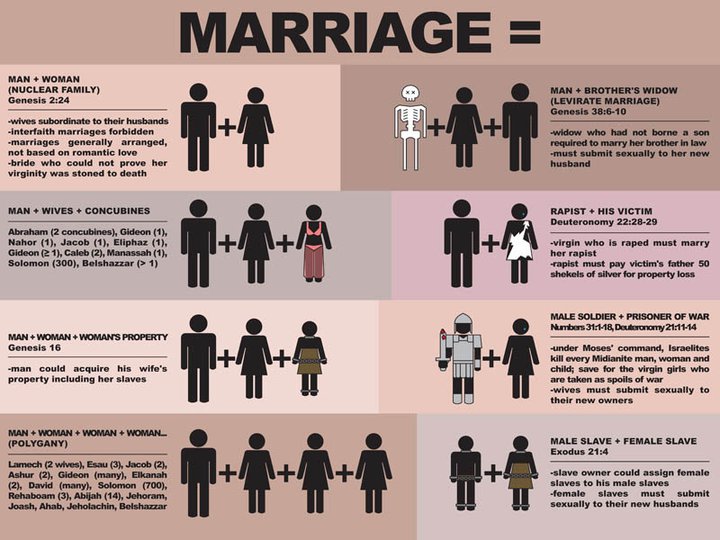
A good summary of permitted and prohibited sexual relations according to the Bible can be seen here: http://bostonbravery.files.wordpress.com/2010/12/bible-marriage.jpg .
Valerie Tarico describes and analyzes in her blog – see: https://awaypoint.wordpress.com/2012/03/29/captive-virgins-polygamy-sex-slaves-what-marriage-would-look-like-if-we-actually-followed-the-bible/ – how God Almighty looks upon sexual relations and marriage according to the Pentateuch.
The big question is: Do Christians follow those rules and laws today? And if we don’t – how is it so?
We must remember what Jesus said according to Matthew 5:17: Do not think that I have come to abolish the Law or the Prophets; I have not come to abolish them but to fulfill them.
(Valerie Tarico is a psychologist and writer in Seattle, Washington and the founder of Wisdom Commons. Her blog is really worth following, especially if you’re an atheist or heretic.)
LikeLike
The new testament requirements for deacons in the church was that they be the husband of only one wife. Generally the epistles are understood to clarify the ways in which the Law was fulfilled and what parts of it still apply even though we are now in a new dispensation of time. I am also an ex-christian, find wisdom in the bible as well as in the scriptures of other religious traditions, without having to swallow whole the mythology. Just wanted to point out that this is the response my fundamentalist former mentors would have had to this argument.
LikeLike
There is no “only” in the requirement that an elder or deacon be the husband of one wife. The Greek here is the ordinal, which is used to mean “first.” Pastors and deacons are required not to be divorced.
The addition of “only” comes from Roman pagan tradition, which forbade a man from having more than one wife – at a time. This addition is similar to Luther’s addition of “only” or “alone” to “faith”: “faith only” or “faith alone.” He did admit, grudgingly, that neither Jesus nor the New Testament said one bit against polygyny. As the Old Testament allowed polygyny, and in some cases positively approved and even mandated it, Luther felt that he could not forbid polygyny.
Hundreds of years passed before strict monogamy was mandated; polygamy forbidden. Women who were unable to obtain a husband were encouraged to enter nunneries. After priests were forbidden to marry, many kept one or more concubines. This practice took more years to stop.
Due in part to the prohibition of bigamy, large numbers of women who wanted to marry and have families were unable to do so except by taking another woman’s husband from her, or by becoming a harlot. Through the ages there was in almost every place a shortage of men. Accident, crime, disease and war took a much heavier toll of men than of women. The same is true today, though the disparity is less.
Under polygyny, if a woman cannot obtain a husband of her own exclusively, she may find (or be found by) a man who has a wife (or wives) already, who is willing to have her. If a man wants children and his wife is unable to bear, he may be able to get a second wife who can bear children. Under monogamy, a man must divorce his wife before marrying another woman. Some women, especially older, welcome a second wife to help out, bear children and help accommodate a husband with a strong libido.
Supply, demand and value operate in human relationships as in economic. When there are more women wanting to marry than men are available, their individual value is lowered and men’s increases. As the opposite is nearly nonexistent, monogamy works against women. A man who wants a different woman has to divorce the one he already has. Under polygyny, he can possibly have a new one without having to get rid of the old one.
Polygynous societies are predominantly monogamous, as there are in most places not enough “extra” women for very many men to have two even if no man was allowed to have three wives.
LikeLike
Until, unless, we realize that the Bible is all metaphor and never was intended to be literal, nothing good will come in understanding it.
LikeLike
More like a man trying to figure out who and where did he come from. You know the Bible was written by a man because starting in Genesis, a man says that God says women should be subservient to man and it is ALL Eve’s fault. The misogyny throughout the old testament is horrific, and then there is the case of Lilith… as well as 2 creation stories. I can’t believe that a loving God told us to do these things, and no Bible thumper will convince me otherwise. The Bible/Torah is for and about the Jewish race and ancient religions and has absolutely no meaning in the 21century for anyone else.
LikeLike
Quote: “The Bible/Torah is for and about the Jewish race and ancient religions and has absolutely no meaning in the 21century for anyone else.”
Words can heal, words can kill – if indirectly. The “bible” is, as implied, a collection of stories, and stories are made of words. Words are also timeless. If modern Earthians choose to apply biblical “teachings” or believe biblical “history” then that makes the bible de-facto relevant to “anyone else” in this time. Arguing over what this or that meant long ago is meaningless. What does it mean today? Now? Denying the influence of biblical thought is like denying the reality of God: God exists, like it or not, because people continue to create and re-create the concept and continue to speak and act within the reality of their creation and here you have a serious majority opinion. Jesus did not argue the validity of the Torah, he taught within that reality and thus ordinary people were able to grasp some of his meanings because he addressed them through their social understanding. On the other hand he alienated much of the leadership because it’s membership was corrupt. The same thing happens today if you “preach” compassion from the very bible these same leaders pretend to extract their corrupt, self-serving thoughts from. Do you know how many times the biblical prophets railed against religious, political and economic corruption, the very same corruption that is bringing down the American “empire” and was blatantly demonstrated in the 2008 bankster bailouts?
One quote, from Amos, judgment on Israel: “{…} They sell the righteous for silver, and the needy for a pair of sandals. They trample on the heads of the poor as upon the dust of the ground and deny justice to the oppressed. {…}”
The bible is a tool. You can use a pitch fork to load hay that will feed cattle throughout a long, bitter winter, or you can use it to skewer your neighbor. It’s not the fork’s choice, it’s entirely your own.
As an ex-Christian, I continue to “search the scriptures” for my own enlightenment, and they have proven quite helpful, especially in engaging meaningful conversations with Christians. One line alone would make scriptures worthy of contemplation: “Do unto others as you would have them do unto you.” Simple enough, clear enough. Requires no interpretation or religious attachments. My question, when encountering such commands in a book is, “do I live that way?” It’s not, “is that line worth considering if the book has bad information, obsolete concepts? If we already know which parts are bad or obsolete, we can put those aside and focus on the parts that still feed our need for truth; for answers to the endless, “what if?” Because others misuse a tool doesn’t make the tool a bad thing. They need to be taught how to use it properly. Telling them to throw it away won’t help – they may well find another, worse, tool to carry on with, as man’s technology demonstrates on a rising basis. There’s an old proverb that says, “Don’t throw away the baby with the bath water.” If people made the effort to apply logic and common sense and common decency to their communications they would avoid the “tweet” comments that satisfy one’s pride (or anger) for a second but only give rise to more misunderstandings or arguments over nothing – long after the original point has been left in the dust. People living in a majority “Christian” environment who go about resisting the concept of a living God, or advocating that the bible be gotten rid of are living in complete denial of their reality instead of addressing it.
If you resolve your personal religious/biblical problems by the not-so-simple expedient of rejecting God and the bible outright, that is a choice you have made. It does NOT apply to all and sundry but only to you. Therein lies your key to your own freedom to live as you chose, and choose, to live. Now, just go and live and demonstrate how it works – for you. Let others decide if what they observe makes them re-think their own choices; it’s not your concern. (Note: my use of “you” is meant generically, not personally.)
LikeLike
I don’t believe in prophets either.A Man wrote the Bible to suit his needs, and women are just as equal as men. What about the two creation stories?
LikeLike
(Another long answer for you) It’s not a question of what “you” believe “in”; it’s a question of communication and discovery. The prophets obviously existed for someone wrote those books. They are part of the history of the two nations of Judah and Israel, however they came about. I have a saying that has worked very well: “Believe all things, believe in nothing.” That’s another key to freedom of mind. Whatever one believes “in” that is one’s god, idol, mastering thought. Self empowerment can accept “what is” without fear or anger. Another great line I find useful: “Believe what you will but don’t believe it here!” Again, if meant honestly it allows the interlocutors the freedom to withdraw from each other without having to draw blood in the bargain. In my rather long comment, I wasn’t asking anyone to believe “in” the Bible, just to consider what is written in it and by innuendo, pointing out that literal biblicists obviously demonstrate that they are anything but. It is easy to turn the tables on those people, if one likes entering into fruitless arguments. You cannot argue against belief systems or people stuck in them. At best, you may make a point. Then it’s best to simply walk away.
The two creation stories as been an area of great interest for me. They are easily understood if one knows enough “archeological” history. The first “creation” story is interpreted following the casting down of Lucifer to earth (not asking anyone to believe that story either at this point). When I learned that Lucifer was the original “creator” of Genesis Chap. 1 to Genesis Chap. 2, verse 3, I did a lot of research. Who was Lucifer? What happened in “heaven” when war broke out, and what was the real reason behind the struggle? These are all interesting questions I cannot answer in a comment. Suffice to say that Lucifer is the original “God” who participated in the six days of creation and made a very nice world out of HER effort. Yes, Lucifer was/is a female. Many ages passed as earth became more and more of a paradise as was the original intent. Then came those the bible call the Elohim whose leader was “the LORD God” – a lesser deity, or alien character, if you will, who was given the task of taking over the earth and basically enslaving it for his people whom I call for lack of a better name, the Jehovians. These are a male-dominated “alien” species that rules much of this universe. They are also known as the Time Lords. They are a warmongering, conquering, misogynist species (and consequently, having made man in their image, the same problems exist here). Again, I can’t go into the whole history of this in one comment, but the writers of Genesis, while tasked to hide the truth of earth’s strange beginnings, did not manage to completely merge the first account of creation with the second because their lesser LORD God did not create anything. He made, he did not create. The account of Adam and Eve is explained in clay tablets found under ancient Sumer. Most Earthians have a block that prevents them to accept certain facts regarding their beginnings and the reason for their existence. Hence, any talk of, say, aliens having cloned humanoid male and female slaves for themselves is immediately relegating to the trash bin of conspiracy theory. As someone recently said, the default setting for Earthians is denial. To that I would add forgetfulness. “We don’t want to know why, we just want to argue, fight, and kill each other over it without ever having to know the source of our distrust and perpetual unease.” Self-styled intelligent, sentient creatures with big brains functioning way below capacity – by programming, by fear, and eventually, by choice. Best I can do on your questions, sorry.
LikeLike
Couple of grammatical errors in my longish comment. But this is a question for you: Who or what “man” wrote the bible, and what was his intent in doing so? When did this man actually write the text, and what sources did he use for his manifold stories and bits of history? How did a book written by one man become such a powerful text, upholding one people’s history and religion, and a major religious cult, Christianity? Just curious, I had never heard it said, or ever read, that one man actually wrote the bible. Thanks.
LikeLike
A group of men, as in political religion. The men in the bible are for men and NOT women.
LikeLike
Ok, I see what you mean now, thanks. And certainly no arguments from me on your comment about the bible being used as a misogynist tool; in fact many of those “biblical” type societies are alive and well today, particularly in the Arab/Muslim world, but not far behind and desperate to make a come-back are Americanadian Christian fundamentalists.
LikeLike
Reblogged this on Forfatterdebatten and commented:
Hvor langt kan man gå mht kritik af religionen i vore dage uden at blive lagt for had? Jg synes, at kendsgerninger er det,d er tæller, men ved godt, at der er andre, der ikke er enig med mig ….
LikeLike
Pingback: Boxing Day Links | Font Folly
Pingback: Happy New Year, And Yes, That’s Me In The Corner… | herlander-walking
What is “gay” marriage? I thought all marriages ideally were supposed to be happy!
LikeLike
If the bible was the word of God and was meant to be used as a guideline of good living, Why then is it so full of enigmas, atrocities and lies? Why wouldn’t it be clear and understandable? And the bible clearly takes it’s stories in the old testament from ancient religions way BEFORE any Christianity and Bible was written
LikeLike
Did the monotheism of Egyptian Pharaoh Akhenaten influence Moses?
“Israelite monotheism developed through centuries of discussion, declarations of faith and interactions with other societies and other beliefs”
LikeLike
700 wives sweet, I’m in!
LikeLike
This doesn’t seem to be very well thought-out. I mean, I know you have a lot of examples, but my basic thought is this: If you were to read a history book, would you say that the just because something happened it was therefore condoned? Why then do you read the historical references as condoning a behavior?
Also, doesn’t Jesus also talk about marriage and divorce and say that he made a law regarding divorce because of the people’s hardness of heart. Therefore, there are some laws in place in order to protect people on the basis of their sinfulness. And, when Jesus talks about marriage, he talks about it from the beginning being between one man and one woman. So, he goes to creation and not to the examples of other people like Abraham or David or Solomon – since the Bible clearly even says that these men sinned in other ways, too.
I’m not saying I have all the answers, but at least in these two points, it seems there could be more clarity (or a better argument made from your perspective).
LikeLike
If the stories in the Bible were condemned or punished that would be different. But instead they are rewarded and sanctified. God blesses sexual slavery. He orders the taking of the captive virgins, his law endorses men selling their daughters and killing them if they have reduced their economic value by having pre-marital sex.
LikeLiked by 1 person
It doesn’t matter to biblical “rules” that people like Abraham, David or Solomon “sinned” particularly in the sexual department – they are exalted patriarchs and their “sins” are entirely forgiven. Just as white collar crime by banksters and insider traders is not treated seriously today, in fact is exonerated and encouraged through bailouts, so it always was with those who rate as opposed to those who do not. David was not stoned to death for committing adultery with Bathsheba, nor for having her husband killed, he was given a slap on the wrist by the prophet Nathan and that was that. With that sort of example from biblical leadership, is it any wonder the whole “bible believing” establishment is riddled with inconsistencies, lies, subterfuge and endless exposures of sexual corruption and other aberrations, however much the truth is kept hidden in pastoral closets? Christians want their cake and eat it too. They want to claim the are disciples of Jesus, followers of the Christ, yet at the same time they keep the Jewish scriptures as convenient back-ups for when they fail to live up to Christly standards – which they ALWAYS FAIL TO DO. The Old Testament provides many legalistic opportunities to make a complete mockery of the teachings of Jesus – that’s what makes it so useful as justification for greedy, murderous, sexually immoral behaviour for millions of hypocrites who consider themselves better than anyone else not “saved.”
LikeLike
Actually, David wasn’t given a slight slap on the wrist. His child was killed by god as punishment. Of course that only offers further evidence that the magic sky despot of the holy babble is a vile beast, worthy only of contempt.
LikeLike
Jesus abrogated the Mosaic code that permitted Israelite men to divorce their wives on condition that they issue a formal divorce decree to the woman. She was then free to go and marry another man. The divorce decree protected her and her new husband from accusations of adultery by her former husband, who didn’t want her but who might have an attitude problem from her remarriage.
LikeLike
Intriguing read! It would have tenfold rhetorical power, though, if you quoted, or at least linked, all the verses you discussed. Without textual evidence, your argument has gaping holes that academics and fundamentalists alike can easily tear at. Also, many Christians won’t make it far in the article without proper citation- it’s an easy way for them to discard your argument completely. Looking forward to a revised edition!
LikeLike
Hi Rich –
I did provide specific Bible references, but you’re right, I could have linked them as well.
LikeLike
The author is confusing a recorded history with instructions from God. The Bible is full of sinners and their sins. Don’t confuse the two.
LikeLike
No, actually I only listed examples that the Bible God approved, blessed, or explicitly commanded. Did you read the article and references?
LikeLiked by 1 person
Pingback: Valerie Tarico – Moderate Christians Condemn Hate Mail and Threats against Military Religious Freedom Foundation | MRFF
You mention David as being the first king of Israel. Reread your bible. The first king was Saul – who is inferred to have possibly had homoerotic feelings towards David when he was a boy…
LikeLike
How I wish I’d access to this kind of information back when I was a young Christian. How I anguished over the atrocities of the bible. THAT god was nothing like the one we were taught in church!
I turned out to be one of those Christians who actually DID read the bible. Studied it like a maniac back in the day. The more I learned, the less I liked that god. And in the end, it’s the reason I left the faith. It’s mind-numbingly exhausting to make excuses for god’s behavior. Wore myself out trying to defend him, especially as a female trying to defend misogynistic bible references that offended me to my essence.
That is what ultimately did me in … the misogyny. After 40 years in the faith, I tossed the book in the trash. Any god who gives women over to be raped as a prize is not worthy of my worship … or one more minute of my time. The god of the bible is a supernatural sexist with zero super powers.
LikeLike
Yeah, th’ wimmins shudda bin kilt long widda menfokes stedda bein let live.
Wudja be happy wid dat?
LikeLike
Personally I’d rather die than become a sex slave of the enemy.
LikeLike
Pingback: 15 Weird Catholic Ideas That May Affect Your Sex Life Even If You’re Not Religious. | Occupy The Vatican
The frequency of Jewish men mating with non-Jewish women, as concubines, slaves, and prisoners of war, in the Old Testament, underscores the fact that the Jews are not a race, and that they probably never were a race, contrary to the Jews’ insistent and erroneous description of themselves as “Semites”.
LikeLike
“Semite,” “semitic,” is a language classification, not ethnic. The majority of speakers of semitic languages speak Arabic. A small number speak Hebrew and a few villages preserve Aramaic.
The patriarch Sem, or Shem, is the named ancestor of many tribes and nations besides Jews, who are mostly of Turko-Mongol heritage, though a minority are Sephardic (“Sepharad” = Spain), who live mostly around the Mediterranean. They are the remnant of Israelites whose forebears populated Judea, Samaria and Galilee.
LikeLike
Pingback: Fuck Celibacy – Irreverently
Reblogged this on andrewpaulkleinblog and commented:
The point is that marriage has changed tremendously since the Iron Age when the Bible was written. For centuries, concubines and polygamy were debated by Christian leaders – accepted by some and rejected by others. The nuclear family model so prized by America’s fundamentalist Christians emerged from the interplay between Christianity and European cultures including the monogamous tradition of the Roman Empire. As humanity’s moral consciousness has evolved, coerced sex has become less acceptable even within marriage while intertribal and interracial marriage has grown in acceptance. Today even devout Bible believers oppose sexual slavery. Marriage, increasingly, is a commitment of love, freely given. Gay marriage is simply a part of this broader conversation, and opposition on the part of Bible believers has little to do with biblical monogamy.
LikeLike
BIBLE IS RELIGION FOR RAPERS AND KILLERS:
Abraham preparing to sacrifice his son to God (Genesis 22:1-18)
Kill first-born humans and animals (Exodus 13:2)
More human sacrifice (Leviticus 27:28-29)
Jephthah Burns His Daughter (Judges 11:29-40 NLT)
God Commands Burning Humans (Joshua 7:15 NLT)
Josiah and Human Sacrifice (1 Kings 13:1-2 NLT) (2 Kings 23:20-25 NLT)
Human Sacrifice (Wisdom 3:5-7 NAB The Book of The Wisdom of Solomon is mostly in Catholic versions of the Bible.)
Child Sacrifice (Wisdom 14:21-23 RSV The Book of The Wisdom of Solomon is mostly in Catholic versions of the Bible. This passage condemns human sacrifice but acknowledges that it did happen by early God worshipers.)
Humans are Fuel for Fire (Ezekiel 21:33-37 NAB)
Burn Nonbelievers (Deuteronomy 13:13-19 NLT)
Rape
Murder, rape, and pillage at Jabesh-gilead (Judges 21:10-24 NLT)
Murder, rape and pillage of the Midianites (Numbers 31:7-18 NLT)
More Murder Rape and Pillage (Deuteronomy 20:10-14)
Laws of Rape (Deuteronomy 22:28-29 NLT)
Death to the Rape Victim (Deuteronomy 22:23-24 NAB)
David’s Punishment – Polygamy, Rape, Baby Killing, and God’s “Forgiveness” (2 Samuel 12:11-14 NAB)
Rape of Female Captives (Deuteronomy 21:10-14 NAB)
Rape and the Spoils of War (Judges 5:30 NAB)
Sex Slaves (Exodus 21:7-11 NLT)
God Assists Rape and Plunder (Zechariah 14:1-2 NAB)
Slavery
Slaves are clearly property to be bought and sold like livestock (Leviticus 25:44-46 NLT)
How Hebrew slaves are to be treated (Exodus 21:2-6 NLT)
It is moral to sell your own daughter as a sex slave (Exodus 21:7-11 NLT)
You can beat both male and female slaves with a rod so hard that as long as they don’t die right away you are cleared of any wrong doing (Exodus 21:20-21 NAB)
Slavery is still approved of in the New Testament (Ephesians 6:5 NLT) (1 Timothy 6:1-2 NLT)
Beating slaves who didn’t know they did any wrong (Luke 12:47-48 NLT)
Murder
Kill People Who Don’t Listen to Priests (Deuteronomy 17:12 NLT)
Kill Witches (Exodus 22:17 NAB)
Kill Homosexuals (Leviticus 20:13 NAB)
Kill Fortunetellers (Leviticus 20:27 NAB)
Death for Hitting Dad (Exodus 21:15 NAB)
Death for Cursing Parents (Proverbs 20:20 NAB) (Leviticus 20:9 NLT)
Death for Adultery (Leviticus 20:10 NLT)
Death for Fornication (Leviticus 21:9 NAB)
Death to Followers of Other Religions (Exodus 22:19 NAB)
Kill Nonbelievers (2 Chronicles 15:12-13 NAB)
Kill False Prophets (Zechariah 13:3 NAB)
Kill the Entire Town if One Person Worships Another God (Deuteronomy 13:13-19 NLT)
Kill Women Who Are Not Virgins On Their Wedding Night (Deuteronomy 22:20-21 NAB)
Kill Followers of Other Religions (Deuteronomy 13:7-12 NAB) (Deuteronomy 17:2-5 NLT)
Death for Blasphemy (Leviticus 24:10-16 NLT)
Kill False Prophets (Deuteronomy 13:1-5 NLT) (Deuteronomy 18:20-22 NLT)
Infidels and Gays Should Die (Romans 1:24-32 NLT)
Kill Anyone who Approaches the Tabernacle (Numbers 1:48-51 NLT)
Kill People for Working on the Sabbath (Exodus 31:12-15 NLT)
Kill Brats (2 Kings 2:23-24 NAB)
God Kills the Curious (1Samuel 6:19-20 ASV)
Killed by a Lion (1 Kings 20:35-36 NLT)
Killing the Good Samaritan (2 Samuel 6:3-7 NAB)
Kill Sons of Sinners (Isaiah 14:21 NAB)
God Will Kill Children (Hosea 9:11-16 NLT)
Kill Men, Women, and Children (Ezekiel 9:5-7 NLT)
God Kills all the First Born of Egypt (Exodus 12:29-30 NLT)
Kill Old Men and Young Women (Jeremiah 51:20-26) (Note that after God promises the Israelites a victory against Babylon, the Israelites actually get their butts kicked by them in the next chapter. So much for an all-knowing and all-powerful God.)
God Will Kill the Children of Sinners (Leviticus 26:21-22 NLT)
More Rape and Baby Killing (Isaiah 13:15-18 NLT)
More of Samson’s Murders (The Lord saves Sampson from standing trial for 30 murders and arson by allowing him to kill 1000 more men.) (Judges 15:14-15 NAB)
Peter Kills Two People (Acts 5:1-11 NLT)
Mass Murder (1 Samuel 15:2-3 NAB)
You Have to Kill (Jeremiah 48:10 NAB)
The Danites Kill the Next Town (Joshua 19:47 NAB)
God Kills Some More (Jeremiah 15:1-4 NLT)
God Promises More Killing (Ezekiel 35:7-9 NLT)
The Angel of Death (Exodus 23:23 NAB)
Destruction of Ai (Joshua 8:1-29 NLT)
Killing at Jericho (Joshua 6:20-21 NLT)
God Kills an Extended Family (1 Kings 14:9-16 NLT)
Mass Murder (Judges 20:48 NAB)
The Angel of Death (2 Kings 19:35 NAB)
Kill Your Neighbors (Exodus 32:26-29 NLT)
Kill the Family of Sinners (Joshua 7:19-26 Webster’s Bible)
Kill Followers of Other Religions (Numbers 25:1-9 NLT)
Murder (1 Kings 18:36-40 NLT)
Kill All of Babylon (Jeremiah 50:21-22 NLT)
Micah Kills a Whole Town (Judges 18:27-29 NLT) (Note that God approves of this slaughter in verse 6.)
LikeLiked by 1 person
Yes. I have written about that elsewhere. And so is the Quran.
LikeLiked by 1 person
This just came through to me from a friend in America, but only Americans can sign it. I give you the link if you wish to just post it up for people.
https://petitions.whitehouse.gov/petition/order-marines-rescue-child-sex-slaves-under-getty-center-la-2
LikeLike
The Talmud is even more full of this stuff. Remember that Christianity, Islam and Judaism are called the “Abrahamic Religions” – ALL connected. All full of ****. The Jews of today, 98% Ashkenaz or European are not the Jews/Hebrews of the Bible who were from an Yemini tribe in Africa. Another Yemini tribe which wears flowers in their hair to cover the BO, were the ones who got together with Mohammed to write the Quran. These tribes were all war-like, they were desert dwellers.
LikeLike
I note the good Dr fails to take cognizance of the fact the Old Testament is very concerned about not sex, but procreation. Kids died young; you didn’t get too attached if you could help it before they turned 5. Women died in childbirth or through miscarriages.
A lot.
You did what you had to to keep the line going.
LikeLike
Pingback: Por que o estupro é tão intrínseco à religião - Bule Voador
A PROPHET LIKE MOSES
We often hear people say,
“If only Jews would return to the Law of Moses!
“Instead, they follow their secular, atheistic, and Zionist ways!”
NUMBERS 31:13-18:
(13) Moses, Eleazar the priest, and all the leaders of the community went to meet them outside the camp.
(14) But Moses was furious with all the generals and captains who had returned from the battle.
(15) “Why have you let all the women live?” he demanded.
(16) “These are the very ones who followed Balaam’s advice and caused the people of Israel to rebel against the Lord at Mount Peor. They are the ones who caused the plague to strike the Lord’s people.
(17) So kill all the boys and all the women who have had intercourse with a man.
( 18 ) Only the young girls who are virgins may live; you may keep them for yourselves.
The rest of Chapter 31 is concerned with distributing the Midianite plunder. Thirty-two thousand (32,000) virgin girls were counted in the booty (Verse 35). Thirty-two of these were given to “the Lord.” That is, 32 of these little girls were set aside for the Levities (heave offerings), to be used as concubines (Verses 40 and 41).
Yes, Numbers 31 says what it says.
The Babylonian Talmud sages used Numbers 31 to justify having sex with children. And since the Talmud sages, along with Christians, regard the Old Testament as “the word of God,” why beat up on the Talmud sages? Why not beat up on Jehovah and Moses, who set the standards?
For further discussion of Jewish teachings on sex with children, see the Babylonian Talmud, Tractate Yebamoth 60b, Soncino 1961 Edition, page 402. Discussion and links at
http://www.come-and-hear.com/editor/america_2.html
TORAH JESUS ENDORSES TORAH
For truly I tell you, until heaven and earth disappear, not the smallest letter, not the least stroke of a pen, will by any means disappear from the Law until everything is accomplished.
Matthew 5:18
JESUS ENDORSED MOSES:
“Do not think that I will accuse you before the Father. Your accuser is Moses, in whom you have put your hope. 46 If you had believed Moses, you would believe Me, because he wrote about Me. 47But since you do not believe what he wrote, how will you believe what I say?”…
John 5:45 47
JESUS WAS A PROPHET LIKE MOSES
The Old Testament contains hundreds of prophecies about the Messiah; where he would be born, his lineage, what he would accomplish, how he would die. We also know that he would be a king like David (Jeremiah 23:5-6), a priest like Melchizedek (Psalms 110:4) and a prophet like Moses (Deuteronomy 18: 15-19).
This article is about what it means for Jesus to be a ‘Prophet like Moses’.
What did Moses Say about Jesus?
Moses is one of the most revered figures in Judaism as he is the one that God chose to give the Torah (Law) to at Mount Sinai. The “Torah” is the first five books in what Christians call the Old Testament – Genesis, Exodus, Leviticus, Numbers and Deuteronomy.
“To believe Moses” means to believe what he wrote.
Jesus said to the Jews that did not believe in him that if they really believed Moses, they would believe him;
“For if you believed Moses, you would believe me, because he wrote about me. But if you don’t believe his writings, how will you believe my words?” (John 5:46).
The Old Testament is so full of references to Jesus that He taught the disciples about Himself from the Law of Moses and from the Prophets on the road to Emmaus;
“He said to them, “How unwise and slow you are to believe in your hearts all that the prophets have spoken! Didn’t the Messiah have to suffer these things and enter into His glory?” Then beginning with Moses and all the Prophets, He interpreted for them the things concerning Himself in all the Scriptures.” (Luke 24:25-27)
Moses said that God would send a prophet like himself and that we must listen to him — in fact says that if we don’t listen, God will hold us accountable;
“The Lord your God will raise up for you a prophet like me from among your own brothers. You must listen to him.
This is what you requested from the Lord your God at Horeb on the day of the assembly when you said, ‘Let us not continue to hear the voice of the Lord our God or see this great fire any longer, so that we will not die!’ Then the Lord said to me, ‘They have spoken well.
I will raise up for them a prophet like you from among their brothers. I will put My words in his mouth, and he will tell them everything I command him. I will hold accountable whoever does not listen to My words that he speaks in My name. (Deuteronomy 18: 15-19)
Jesus was the Prophet like Moses that God raised up
There were many parallels between Moses and Jesus; as infants both Moses and Jesus were almost killed by ruler’s edicts and both were protected from harm, both spent their early years in Egypt, both cured lepers (Numbers 12:10-15; Matt. 8:2-3) and both were initially doubted in their roles by their siblings. Moses lifted up the brazen serpent to deliver those that had faith and Jesus was lifted up on the cross to deliver all who would have faith. Moses appointed 70 elders to rule Israel (Num. 11:16-17); Jesus appointed 70 disciples to teach the nations (Luke 10:1, 17). But the most striking comparison between Jesus and Moses was that they were both prophets that taught the Law of God.
Yes, Jesus like Moses taught the Law — the true meaning and practice of the Law as given by God.
As a Prophet, he was calling the Jews back to the Law as God gave it, rather than what the Pharisees had made it.
The Standard of the Prophet
As a Prophet, Jesus had to meet the same criteria that God set for all prophets; that is
To uphold what God has said or be put to death.
This ought not to be overlooked.
Prophets in the Old Testament were to be put to death if what they said did not come to pass or if what they taught caused the people to stray from the way God had already spoken.
The standard for a prophet is spelled out in the Law of Moses;
“If a prophet or someone who has dreams arises among you and proclaims a sign or wonder to you, and that sign or wonder he has promised you comes about, but he says, ‘Let us follow other gods,’ which you have not known, ‘and let us worship them,’ do not listen to that prophet’s words or to that dreamer. For the Lord your God is testing you to know whether you love the Lord your God with all your heart and all your soul. You must follow the Lord your God and fear Him. You must keep His commands and listen to His voice; you must worship Him and remain faithful to Him. That prophet or dreamer must be put to death, because he has urged rebellion against the Lord your God who brought you out of the land of Egypt and redeemed you from the place of slavery, to turn you from the way the Lord your God has commanded you to walk. You must purge the evil from you.” (Deuteronomy 13: 1-5)
The Teachings of Jesus and the Law
Some people believe that the teachings of Jesus as recorded in the New Testament teach something different than what is taught in the Law of Moses or that He gave them new meaning or disregarded the Law; even breaking some of its commands. Finally, others would say Jesus fulfilled the Law and therefore the Law is no longer relevant.
Let’s look at each of those a bit closer;
1. Some people believe that the teachings of Jesus were very different than what was taught in the Old Testament; that the Old Testament was all about the law and the New Testament is all about grace. This idea is worth an article in itself at very least, but let’s look at this idea in terms of what Deuteronomy 13 says. If Jesus taught something different (e.g. grace) than what God had previously taught (e.g. Law), then He would have been leading us away from keeping God’s commands and this would have made Him a false prophet, deserving of death.
2. Others say that Jesus gave ‘new meaning‘ to what was taught in the Old Testament but this too would have made Him a false prophet. If Jesus reinterpreted the Law of Moses, He would have been urging us to rebellion against the Lord and His commands and we would have been just to put Him to death.
3. Still others say that Jesus broke all kinds of commands in the Law of Moses and often cite Him healing on the Sabbath as a common example. Jesus did not follow the “Oral Law” of the Pharisees and thus in their minds would have been viewed as breaking the Sabbath, but nowhere in Scripture are there any instances of Him violating any of the commands of the (Written) Law, as recorded in the Law of Moses. Furthermore, if Jesus had indeed broken the Law of Moses — the Law given by God, He would have committed a sin and no longer been the Lamb of God without blemish.
4. Finally, others say Jesus fulfilled the Law and therefore the Law is no longer relevant. Jesus as the Prophet like Moses was calling the Jews back to a true observance of the Law of which He is the goal (Romans 10:4). Some translations use the word “end” for goal, but the word in Greek [telios] is more clearly understood in the context of Romans 10 as goal. In this context, Paul is referring to the Jews as disregarding the righteousness from God and attempting to establish their own righteousness. Again, this refers to the Pharisees insistence that the observance of “Oral Law” (i.e. ‘the traditions of men’) are equivalent in authority to the Written Law — which is the Law of God. Paul says that they [the Jews] have NOT submitted themselves to God’s righteousness [as embodied in the Law] — of whom Christ is the goal.
None of the teachings of Jesus recorded anywhere in the New Testament teach something new or different than what is taught in the Law of Moses and at no time does Jesus ever break the commands of the Law, as given by God. In the following examples, we demonstrate that Jesus considered the Law not only relevant to teach, but to exhort believers to practice.
Jesus upholds the Law
Here are four examples as to how Jesus, as the Prophet like Moses, upholds the Law of Moses;
1. Jesus and the Rich Young Man
The synoptic gospels record the conversation between Jesus and the rich young man who wanted to know how to inherit eternal life.
Jesus could have simply replied “follow me” but he doesn’t. He reminds the man of the commandments of God in the Law forbidding adultery, murder, stealing, bearing false witness and honouring one’s parents (Mark 10:17-22; Matt 19:16-30; Luke 18:18-30). Jesus upholds the Law.
It was when the young man said that he had kept these commands from the time he was a youth that Jesus said to sell all he had, distribute it to the poor and follow Him (Luke 18:18-23, Mt 19:19-21, Mark 10:17-21). Jesus continues to uphold the Law in His reply by telling the man to sell all his possessions. He was pointing out that money had become an idol to the man which kept him from keeping the first two commandments; which is to have the Lord as our God and no other gods before Him, and not to make an idol — which money had become to the man. Jesus upholds the Law all the way through this teaching.
2. Jesus and the Jewish Lawyer
In the conversation between Jesus and a Jewish lawyer recorded by Mark and Matthew, the issue of which is the greatest of the 613 commandments came up.
A question had arisen among the Jews and was now put to Jesus as to which commandment was ‘the first of all’ (Mark 12:28), or ‘the greatest’ (Matthew 22:34) — first and greatest both referring to the same thing.
In Matthew’s and Mark’s account (Mark 12:31, Matthew 22:39), Jesus replies to the Jewish lawyer saying that ‘the greatest and first commandment’ was to love God with all your heart, soul and strength (Deuteronomy 6:5) and adds ‘the second is this, “You shall love your neighbour as yourself” (Leviticus 19:18). Jesus upholds the Law.
JESUS AND TORAH
Moderate Christians love to talk about how Jesus fixed the Old Testament, or, in other words, obsoleted the horribly offensive parts about slavery, keeping women in their place, killing gays, etc. In fact, he did no such thing.
1. Jesus fully supported everything in the Old Testament
Here is Jesus speaking specifically on the topic of Old Testament teachings:
THE LAW STANDS
“For truly, I say to you, till heaven and earth pass away, not an iota, not a dot, will pass the law until all is accomplished. Whoever then relaxes one of the least of these commandments and teaches men so, shall be called least in the kingdom of heaven; but he who does them and teaches them shall be called great in the kingdom of heaven.” — Matthew 5:18-19
“It is easier for Heaven and Earth to pass away than for the smallest part of the letter of the law to become invalid.” (Luke 16:17)
“Do not think that I have come to abolish the law or the prophets. I have come not to abolish but to fulfill. Amen, I say to you, until heaven and earth pass away, not the smallest part or the smallest part of a letter will pass from the law, until all things have taken place.” (Matthew 5:17)
“Did not Moses give you the law, and yet none of you keepeth the law” (John7:19)
Keep in mind, this is Jesus saying this – in the Bible that all Christians own and cherish. Don’t take my word for it; look it up–it’s all there.
So now that we understand that he fully supported what’s in the Old Testament, let’s take a look at what he actually just commanded us to uphold.
THE LAW THAT STANDS
Blasphemy is Punishable by Death
One who blasphemes the name of the LORD shall be put to death; the whole congregation shall stone the blasphemer. Aliens as well as citizens, when they blaspheme the Name, shall be put to death. (NRSV) — Leviticus 24:16
Cheaters Must Die
If a man commits adultery with another man’s wife—with the wife of his neighbor—both the adulterer and the adulteress must be put to death. (NIV) — Leviticus 20:10
Dishonoring Your Mother or Father is Punishable by Death
Anyone who dishonors father or mother must be put to death. Such a person is guilty of a capital offense. (NLT) — Leviticus 20:9
People Who Work on Sabbath Should be Killed
You have six days each week for your ordinary work, but the seventh day must be a Sabbath day of complete rest, a holy day dedicated to the LORD. Anyone who works on that day must be put to death. (NLT) — Exodus 35:2
If a Woman is Not a Virgin When She Gets Married, She Has to Die
“If any man takes a wife, and goes in to her, and detests her, and charges her with shameful conduct, and brings a bad name on her, and says, ‘I took this woman, and when I came to her I found she was not a virgin,’ … and evidences of virginity are not found for the young woman, then they shall bring out the young woman to the door of her father’s house, and the men of her city shall stone her to death with stones … (NKJV) — Deuteronomy 22:13-14,20-21
There’s Nothing Wrong With Slavery
Your male and female slaves are to come from the nations around you; from them you may buy slaves. (NIV) — Leviticus 25:44
Sodomites Should be Put to Death
If a man lies with a male as with a woman, both of them have committed an abomination; they shall be put to death; their blood is upon them. (NRSV) — Leviticus 20:13
Women Should Keep Quiet and Do as They’re Told
A woman should learn in quietness and full submission. I do not permit a woman to teach or to have authority over a man; she must be silent. (NIV) — Timothy 2:11-12
Keep in mind, these aren’t suggestions. They’re not optional. Remember what Jesus said,
“Whoever then relaxes one of the least of these commandments and teaches men so, shall be called least in the kingdom of heaven…”
He also said they’re not open to any personal interpretation. It’s all very clear to anyone willing to actually read the Bible.
LikeLike
Pingback: Catholic Group Launches “Hide The Pride” Campaign To Check Out LGBTQ-Related Books From Public Libraries – Scottie's Playtime